Thursday, February 3, 2022

Eureka Apprentice - Week 2 - Feb. 10, 2022

Eureka Apprentice - Week 2 - Feb. 10, 2022

Study/Learn:

--Brain Work--

"There is no such thing as a good memory, or a bad memory.

Just an untrained memory"

--Jim Kwik

In class we talked about FOCUS. As you study this week, use at least 2 of these practices to up your focus, and help you remember the material better:

1. Before Study begins, take 4 deep, cleansing breaths. This helps to focus and center your mind. If you wish, use the 4-7-8 method for breathing. Here are the steps:
  • Exhale completely through your mouth, making a whoosh sound.
  • Close your mouth and inhale quietly though your nose to a mental count of 4
  • Hold your breath for a count of 7.
  • Exhale completely through your mouth, making a whoosh sound to a count of 8.
Repeat breaths for a total of 4.

2. If your mind feels like it's bouncing from place to place, remember it's not your mind, it's your awareness, and you can reign it in! Imagine a glowing ball of light moving to different parts of your mind. When trying to focus, you need to train yourself to keep that ball of light focused on 1 spot in your mind for 10-25 minutes. If you can do this, you will train your will-power, and see impressive results.

3. Do something that has been causing you stress. Sometimes *something* you've been avoiding is weighing on your mind, to the point that it's all you can think about. If this is your situation, go resolve the "thing," the issue, the stress. Then come back to study, do the breathing, and prepare your mind to focus.

4. Schedule a time for your distractions. While you're studying, your mind will try to distract you in a million different ways. Thinking about friends, games, movies, other commitments, etc, etc, etc. Give your brain a time that you will be able to think about these things. For example, if you're struggling to focus in the moment, because you can't stop thinking about what you might do with your friends later, just tell your brain: "Right now I need to focus on __________. I can think about my friends at 2:15. That allows your brain to rest, knowing you can come back to that thought.

5. Only study for 10-25 minute increments. Find out what works best for your brain. After you study for that increment, do one of these activities for about 5 minutes, then go study for another increment, until you are done studying:
  • Tell someone what you just learned
  • Write down what you just learned
  • Do some physical exercise
  • Grab a healthy snack
Happy Studying!


--Marine Biology--

Kingdoms of Marine Life

All living organisms NEED three things: water, air to breathe(oxygen), and food. Living organisms can DO three things: move, grow, and reproduce.   Do you think that organisms in the ocean meet all six requirements? Why or why not?

1. Watch this video, Kingdoms of Marine Life. (6:32) 

  • Take notes.  What are the 5 kingdoms?  Name some animals/plants that go in each kingdom. (There will be a kahoot quiz.)

Everything that surrounds us can be put into groups according to shared characteristics; this is called classification. We classify things to help us order, organize, and better understand the things around us.

Classification is especially important to scientists. Scientists have classified all living things: bacteria, protists, fungi, plants, and animals. All of these types of organisms not only live on land but they also live in the ocean. 

2. 

  1. Print out the colorful Marine Living Organism cards on pages 29-31 in your Marine Biology Curriculum.  
  2. Cut them on the dotted lines.
  3. Lay out all the “Marine Living Organisms” cards on the table.  Work with someone to arrange the cards into groups that share similar attributes. You can make as many groups as desired and classify the groups any way you would like. Then explain why you classified their groups that way in you CPB.
  4. Do all of the first 3 steps before you scroll down and see the actual classification. (It will be more fun if you don't peek.) There will be questions on the Kahoot about all the classifications.  Be familiar with the pictures and how they are classified.  Be familiar with the information below about each classification.

Scientists classify living things, but scientists do not always agree on how things should be classified. Sometimes there are changes made or differences in classification. Scientists generally classify marine organisms in the following groups.


Bacteria and Archaebacteria (Cards 1, 4, and 18)
Bacteria and archaebacteria [ar–key–bak–TEER–ee–uh] are often separated into two kingdoms. While they are both bacteria, there are differences between them. Archaebacteria can survive in extreme conditions, like the extreme heat of a hydrothermal vent, as shown on card 1. Archaebacteria are also found in areas of high salt content, like the Great Salt Lake or the Dead Sea. Bacteria are the smallest forms of living organisms; most bacteria cannot be seen without microscopes. Despite their small size, they play a huge role in recycling and decomposing nutrients for the use of all marine life. The role of bacteria is so important that life could not exist without it! 

Fungi (Cards 19 and 23)

Only 5% of the world’s fungi—including mushrooms, molds, and yeasts—reside in the oceans. Fungi help to decompose dead organic material in the ocean. They also live as parasites on other living plants and animals in the ocean.

 Protists (Cards 2, 9, 20, and 24)

Some organisms are plantlike, fungilike, or animallike, but they do not meet the requirements to actually fit into one of those kingdoms. These diverse organisms are collectively classified as protists.

Protists can help to recycle nutrients through the environment. Diatoms, like the ones pictured on card 20, are common types of phytoplankton, which are important for providing the base of the food chain.

Card 2, kelp (seaweed), may seem like an ocean plant, but it does not have the same complex cellular makeup that a plant cell has, so it is classified as a protist. This is also the case for algae (card 24) and red tide (card 9), which is a microscopic algae.

While there is much good that protists provide, they can also be very harmful. Protists are the culprits in spreading diseases like giardia, dysentery, and malaria. Dinoflagellates are protists that produce toxins that cause a type of algae bloom called red tide, as in card 9. A red tide is harmful to sea life and can cause illness in humans if seafood found in a red tide is eaten.

Plants (Cards 7 and 25)

There are few living organisms residing in the ocean that are scientifically classified as plants. With the limited amount of sunlight that penetrates through the water, there is a limited number of plants that grow. The few that do grow are able to handle high salt content and low oxygen levels. They grow in calm, shallow waters.

An example of this is on card 25. These are mangroves. They grow only near the equator where it is warm. They have a large, tangled root system that can handle the tides.

Another type of plant is called seagrass, pictured on card 7. Seagrass is very important to the food chain. Hundreds of animals feed on seagrass, including turtles, crabs, fish, and swans. Dried seagrass was once used for mattress filling and to roof houses.

Animals

Animals are multicellular organisms that eat plants or other animals for their food. When we think of ocean life, this is the kingdom we most likely think of. You can divide the animal kingdom into two groups: invertebrates and vertebrates.

Invertebrates

Invertebrates are animals that do not have backbones. The following are some of the most common marine invertebrates.

Sponges (Card 26)

Sponges are one of the simplest multicellular creatures. They are covered in small pores that move water through the sponge and absorb nutrients or small food particles. Sponges can live almost anywhere in the ocean, from very shallow to very deep waters.

 Cnidarians [ny–DARE–ee–uns] (Cards 5, 16, and 21)

These animals are simple saclike organisms with radial symmetry, meaning they are symmetrical around the center point. They have special cells that sting in order to defend themselves. Animals such as jellyfish (card 16), corals (card 5), and anemones (card 21) are included in this group.

Crustaceans (Card 15)

Crustaceans are part of the arthropod phylum. Arthropods have a segmented body with jointed limbs. In the ocean we see a type of arthropod called crustaceans. They include animals such as crabs (card 15), shrimp, and barnacles.

Mollusks (Cards 13 and 14)

These animals have a head, a large soft body mass, and a leg or legs. Most of them also have a hard external shell. Mollusks include animals such as mussels, clams (card 14), snails, squid, and octopuses (card 13).

 Echinoderms (Cards 8 and 27)

These animals are often star or ball shaped with five-point symmetry. You will recognize animals such as the starfish (card 8) and sea urchin (card 27) in this group.

Vertebrates

Vertebrates are animals that have a backbone, or spinal column. The following are some of the most common marine vertebrates.

Reptiles (Card 12)

Reptiles include turtles (card 12) and snakes. They have dry, scaly skin and lay eggs. Reptiles are different from fish because they lay their eggs on land. Even sea turtles must return to the land to lay their eggs.

Pisces [PIE–seez] (Cards 6, 10, and 22)

These animals are cold-blooded and breathe through gills. Cold-blooded means that their body temperatures change according to the temperature of the environment. Their spines can be made of bone, like in the fish in card 10, or cartilage, like in sharks (card 22) and rays (card 6).

Mammals (Cards 3, 11, and 17)

Mammals are warm-blooded animals. Warm- blooded means they keep a warm body temperature even when they are in cold water. These animals give birth to and nurse their young. They also are different from fish in that they breathe air and have hair. Mammals include whales (card 3), seals (card 11), and dolphins (card 17). 

3. 

  1.  Go to pages 33 and 34 in your Marine Biology Book.  Look at the classification chart and see how the classification works. 
  2.  Read the bit about getting more specific with sharks. 
  3.  Do the Shark and Ray family dichotomous activity. (The instructions are on page 33.  Substitute science journal for CPB.)
--Coral Reefs--
What classification does coral fall under? (Look above if you don't know.)
We are going to learn more about it.
 

The picture on the right is often what we picture when we think of coral, but what you see here is actually more than a single coral animal. Coral is made of hundreds or even thousands of tiny animals called coral polyps. (below)

If you were to take a very close-up look at coral, this is what you would see— individual animals,  each of them usually no bigger than the eraser on a pencil. Together they form a coral colonyas we saw in the first picture. (Top Right)

Can you see each coral polyp?

Coral Colonies that grow together

form a coral reef.                                                                                            

All coral is divided into 2 types:  

Hard Corals and Soft Corals.

Hard corals are made of calcium carbonate, or limestone. When a coral polyp dies, it leaves behind a hard skeleton on which the new polyps will grow. Thus, the coral grows bigger after each generation. Hard coral tentacles grow in multiples of six.

Soft corals have more protein in their makeup, making them less rigid than hard corals and able to sway with the current. Soft corals are rooted to surfaces other than their parent polyps. Soft coral polyps always have eight tentacles.

4. Go look at the picture of Hard Corals and Soft Corals on page 38. (pictured above) Be familiar with those corals for the kahoot quiz.

5. Read "The Story of a Coral Reef" from chapter 5 in your Marine Biology Book. There will be questions on the kahoot quiz from this reading. (Print and color the coloring sheet if you want.)

6. Watch this video about coral reef communities.  What are the 5 relationships of a coral reef? Write them down in your CPB.

7. Optional:  You will get extra vanbucks if you do this activity.  Go to page 44 in Chapter 5.  Read about how a coral polyp is born and do the activity. (There will be bonus questions on the quiz as well.)


--Exploration--


Marco Polo!

8. Watch this video about Marco Polo (7 min) 

Then pull out your Explorer Map.  Look up Marco Polo's journey, and record

his route on your map.


And just for fun: Watch this Marco Polo Vid


--Around the World in 80 Days--


9. Week 2: Read through Chapter XIV, “In Which Phileas Fogg travels down the whole length of the beautiful Ganges without as much as thinking of seeing it.”


***Add all travels to your *now ongoing* travel log, AND Add to his journey to your

"Around the World" travel map.


Know/Understand: 

1.  Ocean Animal Report:  This week I want you to study one ocean animal that you think is the Most Colorful.  To prepare for this you will need to do these things.

  • Find an ocean animal to study that is the Most Colorful.
  • Print a picture of your animal and bring it to add to our ocean wall. (No pictures on phones! Physical pictures please!)
  • Learn what ocean it is found in.
  • Tell us what Pelagic Zone or Intertidal Zone it is found in.
  • Tell us what classification of Marine Life it is. (you can find stuff on classification on pages 32-33 in the curriculum, or obviously online.)
  • Convince your fellow vanguardians why your choice is the best. (We will break into groups to do this.)
  • You will get 2 minutes to tell us all about your animal, so keep it short, sweet, and convincing!

2. Where in the World is Napoleon the Narwhal? 


Using a Globe, a map (Ok, or your phone or computer, let's face it, we can use the tools we've got).  However, if you really want to try without technology, that would be cool!  Anyway, look up these latitude/longitude points.  This week Napoleon was found in 2 different bodies of water. Remember to write each location on separate sticky notes, with your name.

A: 12.75°N 110.5°E
B: 44.78 N 13.33 E

3. The top 10 brain foods are:

Avocados
Blueberries
Broccoli
Dark Chocolate
Eggs
Green leafy vegetables
Salmon/Sardines/Caviar
Turmeric
Walnuts
Water

Spend no more than 5 minutes memorizing this list the best you can. Then find a way to consume 2 of these every day this week.

4. What do you think is the FASTER way to learn? In your commonplace book, write these letters going down the left side of your page, like this:

F

A

S

T

E

R

Beside each letter of the word FASTER, write a word or idea that might help you learn material faster.  This should be a quick brainstorm, and only take about 5 minutes. There is no right answer.  I just want you to think.  We'll discuss your ideas in class.


Become/Serve:


We all love the story of Lehi and Nephi.  Based on what you already know...how were they inquisitive? Think through their story and write down 2 ways that each of them were inquisitive.

Read Alma 63: 5-7
Who else was inquisitive?  Or in the words of the scripture "exceedingly curious."
Where do you think Hagoth was sending ships?

Now, you can be inquisitive.  Let's consider how Nephi and Lehi made their journey from Jerusalem to the promised land?

Pull out your Scripture Journeys map.  As you watch this 8 min video, map our their journey on your map.  This will only take you to the land of Bountiful.  From there, how do you THINK they made it to the Americas?  Don't plot out the final part of their journey yet!  We'll do that part together in class.


Saturday, January 22, 2022

Eureka Masters


1. Read this book!

2. Come to class ready to discuss how this book uses our theme of Trust.

3. Come with 2 other prepared discussion points.

4. Send a sticker idea to Sister Eagar at tasha.eagar@gmail.com or 801-901-3610
Use the same format you have been doing with Sister Jessee.  She will still be printing them.


We will do some fun knot tying in masters classes.  Lots of contests and lots of vanbucks to be earned. Read the books so you can come!

Sister Andersen will be leading this discussion.

Friday, January 21, 2022

Eureka Journeyman Week 1, Feb 3

 Eureka Journeyman Feb 3, 2022


Ocean Animal Observation

Eureka Journeyman this year is all about observing some ocean animals in more detail.  We will have actual specimens here to to look at and discover.  There will be small amounts of dissection, only to the degree that it will help us all learn about the complexity of the organisms we're studying. In my experience, there is no better way to learn than having a hand-on experience.

We all view these creatures as God's great creations, and in no way wish to diminish the value of their lives.  We will treat all the specimens with respect, and take an approach to observation/dissection with a true desire to gain a deeper understanding of these magnificent creatures.

This week, I hope we're all excited to learn more about the Jellyfish!  Which actually isn't really a fish at all!


Study/Learn

1. Watch this video about Jellyfish:  Jelly Deep dive (5 min)

2. Study Jellyfish.  Write down 10 interesting facts about jellyfish you did not know before, and bring your list to class.  

Here are some questions that could guide you in your study:

What are they made out of?

Do they have a brain, heart, lungs?

How do they sting?

What is bioluminescence and how do they use it?

How have they aided in scientific advancement?

Where are they found?

Etc......

Know/Understand

1Go to page 57 in the curriculum and study the anatomy of Jellyfish. Sketch a jellyfish in your commonplace book, and label the anatomy as shown on page 57.

2. There are over 200 types of jellyfish.  Choose 1 type, and learn about it in a little more depth.  Bring a printed picture (or hand-drawn)  to class to add to our ocean wall.  Tell us a few unique facts about the species you chose.  You'll have 1-2 minutes to share your findings.  


Tuesday, January 11, 2022

Eureka Apprentice Week 1 - Feb 3 2022

 Eureka Apprentice Feb 3, 2022

Study/Learn:

--Marine Biology--

Study the vocabulary words on pages vii-xiii from the beginning of the Marine Biology curriculum we will be using.  Your parents should have this downloaded already.  If not, here is the link. https://www.goodandbeautiful.com/free-downloads/marine-biology/

^^^These will be your note card words to study each week. ^^^

You can cut them out and make flash cards with them, or whatever you want to do to make sure you are studying them on a regular basis.

Imagine that we are all standing safely on the top of these cliffs overlooking the ocean, feeling and smelling the fresh, salty sea wind, hearing the crying seagulls and crashing waves, and gazing out across the mighty, seemingly endless ocean. It’s hard not to have feelings of wonder and awe when we behold the mighty ocean.  We will experience even more awe and wonder as we explore not just what we see on the surface of the ocean, but the wonders in it. In the Bible we read: “O thou that dwellest upon many waters, abundant in treasures . . .” (Jeremiah 51:13). About 71% of the surface of the earth is covered by the ocean. In this unit we will discover the abundant treasures of the ocean and the variety of God’s creations of plants and animals that live in the ocean. 

Before you freak out about all the things you see below this, just know that it will take some time, but it is not very hard.  It's a lot of watching cool things about the ocean. Plan accordingly--it's going to be so fun!

1. Watch any 5 minutes of this Ocean Video.  (It's pretty cool) Take as many screen shots of animals as you want.

Then:

  • Pick your 3 favorite
  • Find out what they are
  • Post them into this google doc. Favorite Screenshots
  • Label the picture and put your name with it.
I put my examples in the doc.


2. What do you notice about the oceans on the earth?
Based on this picture, write down 3 things that you notice about the oceans. (There is no right or wrong answer, I just want to know what you notice.) But, maybe notice where each ocean is! :)

3. Watch this video about Ocean Currents. (length 4:33) Take notes in your notebook.  What is something you learned that you didn't know before?

"The only reason people do not know much is because they do not care much.  They are incurious.  Incuriosity is the oddest and most foolish failing there is."  ---Stephen Fry

Curious: The desire to know.

Always be curious!  Don't fall into the trap that you think you already know something. There is always more to learn even about things we think we already know.

4. Watch these videos to prepare for some experiments in class.


5. Watch this video to learn about the Oceanic Pelagic Zones.(3:32)
In the Marine Biology Curriculum that you downloaded, 
  • Go to Page 5 and look at those animals and be prepared to recognize them.  
  • Go to pages 13-17 in the curriculum (Lesson 2) and read about the different animals that live in each zone. 
  • Look at the diagram on pages 18-19.  Do that if activity if you wish.  It could be fun! 
There will be a kahoot quiz to test your knowledge of these animals and the pelagic zones.

"The Ocean stirs the heart, inspires the imagination and brings eternal joy to the soul." - Robert Wyland
In the Bible we read, “And God called the dry land Earth; and the gathering together of the waters called he Seas: and God saw that it was good” (Genesis 1:10). In this lesson we are going to talk about the place where the dry land and seas meet and the habitats of the ocean along the shore. 

6. Watch all of these videos and take notes. 

There will be questions from the videos in our kahoot quiz.  This quiz in class will be different than the notecard kahoot. (Keep that in mind as you study all the things.)

7. Go read the poem titled "A Life on the Ocean Wave" on page 24 in the Marine Biology Curriculum.  Bonus Vanbucks if you memorize it and pass it off before or after class. (optional)
What is your favorite part about the poem?  Does it speak to you?  Write your thoughts down. (not optional)

8.  Extra Credit! For some extra points on the kahoot, study the vocabulary words on page 25 of the curriculum.  These vocabulary words are different than the notecard vocabulary.  They are good words to know, plus if you win the kahoot, you will get vanbucks!


--Exploration--

With Marine Biology comes an oceanic study of exploration. There are some pretty amazing journeys we're going to "dive into."


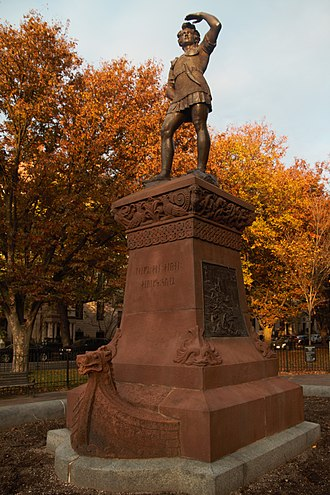
According to many modern historians, the first European to set foot on North America was Leif Erikson.  Do you think they are correct?


9. Look up Leif Erikson and write down 5 facts about him.  Make sure a couple of those facts are unique  enough that no one else will have them.  Look at a map of his expeditions.  Was he the first European to set foot on North America? We'll map out his journey and talk about your observations in class.


10. Phileas Fogg, a meticulous, unchanging, tranquil gentleman in English Society, does something completely out of his routine…takes a bet to travel around the world in 80 days! Can he do it? Each week, we’re going to read 25-30 pages of Around the World in 80 Days by Jules Verne, and track the travels of Phileas.  Since we’re studying oceans, maps and explorers, this will add a fun twist to our studies.

Week 1 : Read through Chapter VIII, “In which Passepartout talks rather more freely, perhaps, than is advisable.”


You will get a specific map in class on which you will track his travels.  So for this first week, simply start a travel log in your CPB, or on a google doc, etc.  Give yourself 4 columns as follows:

Where he Leaves From

Where he Arrives

Method of Travel

How many days it takes


--Brain Work--

(The Other Part of Eureka!)

"The human Brain has 100 Billion neurons, each neuron connected to 10,000 other neurons. Sitting on your shoulders is the most complicated object in the known universe."

--Michio Kaku


Do you often give your brain limitations?  I think we all do.  However, pause for a moment and consider how much your brain does for you (I mean, besides keep you alive and all). We are going to work on breaking limitations within our mind as we study 5 methods to increase our capacity.  In the next 6 weeks we will learn:

*Focus

*Study

*Memory

*Speed Reading

*Thinking

In order to increase all of the above, we MUST be able to free our mind of limiting beliefs, and distractions.  So, your first assignment in our journey of a limitless brain is:

11. For 1 hour this week...during a time when you would normally have your phones with you, or when you might be distracted by a video game.  Set your phone, computer, or video game aside, and do something else.  Leave the electronics in another room (this is going to be especially hard with those who are addicted to their phones), and go do anything else.  Anything!  Don't even use your phone for music.  Be ok to let your mind wander, and listen to the sounds of life around you.  Completely unplug, intentionally.  Read a book, serve a family member, get non-computer related VG homework done, cook dinner for your family, have a conversation, etc. If someone texts during that time, and you hear the chime, ignore it (Unless it's your mom or dad :). You can get back to them later. 

Come to class ready to share your experience.  No throwing rotten tomatoes at Sister Martin for this assignment.  You might even thank me! :) 


Know/Understand

1. Animals of the Ocean are amazing!  Now that you have studied all the things above, I want you dig a little deeper.  In the next 6 weeks you will study a bit more about 1 of the plants or animals that you find fascinating.  We are going to have a little contest with it though.  The categories for the contest are as follows.

Best Camouflage

Most Helpful

Most Unique

Most Dangerous

Most Colorful

Best Defense Mechanism


Just keep these in mind as you learn about the different life in the ocean. Take notes on anything that might fall into these categories. This week we are having a contest to see who can find the Best Camouflaged ocean organism. To prepare for this you will need to do these things.

  • Find an animal to study that has the Best Camouflage.
  • Print a picture of your animal and bring it to add to our ocean wall. (No pictures on phones! Physical pictures please!)
  • Learn what ocean it is found in.
  • Tell us what Pelagic Zone or Intertidal Zone it is found in.
  • Tell us what classification of Marine Life it is. (We will study this more on week 2, but you can find stuff on classification on pages 32-33 in the curriculum, or obviously online.)
  • Convince your fellow vanguardians why your choice is the best. (We will break into groups to do this.)
  • You will get 2 minutes to tell us all about your animal, so keep it short, sweet, and convincing!

2. Using a Globe, a map (Ok, or your phone or computer, let's face it, we can use the tools we've got).  However, if you really want to try without technology, that would be cool!  Anyway, look up these latitude/longitude points.  This video (5:12) will help you know what that means (And you'll get to meet Ally the Alien).  Write down on a piece of paper what body of water these coordinate to.  There will be a reward for the correct answer.

68.8774° N, 3.1397° E


Become/Serve

Read Ether Chapters 2 and 3. In my opinion, this is one of the greatest stories in the Book of Mormon!  As you read, think about how the brother of Jared showed Trust , and be prepared to discuss your thoughts. 


Also, write down any words or phrases that give us clues about their travels (Ether 2:1-7) Write down approximately what year they traveled.


Thursday, April 1, 2021

April Eureka Journeyman

 April Eureka Journeyman


Study/Learn


In our endeavor to THRIVE in any situation, we are going to go over directions and how to use a compass.

1. Bring a compass to class.  We are going to do a compass course, and possibly create one depending on time.  We need 1 compass per 2 people (1 per person if possible).  If you happen to have more than that, please bring them.  If you don't have one, please borrow one, or buy one.  It's a great thing to have anyway, and now you'll have an idea of how to use it!  We will also need these on our campout.

Brother Martin will teach us how to use the compass at the beginning of class.  If you don't have one, you will be lost!  Haha, yes I just said that.


II.  Watch this video to help you understand true north vs. magnetic north.


Know/Understand

Knowing your direction in any given situation is important.  For example, if I'm going to visit the Eagars in Orem, I'm going to drive North.  I KNOW that.  Sometimes people give me directions using the Cardinal directions, which are North, South, East and West.  If I KNOW Orem is North, then I know how to find E, S and W.  That's good to know!  If you know 1 direction, you can know all 4 if you remember this:


If you ever find yourself in a survival situation, finding which direction is which is important.  Why?

We've talked about using the North Star at night to point us North.  What about during the day?  How can we find which direction is which using only the sun or other clues?  There are several ways actually.  Your assignment is:

Research 1 way you can find directions using the sun.  Try it out in your own yard!  Come to class prepared to explain your method.

Become/Serve:

Look up John 14:6 and memorize it.

April Eureka Apprentice

April Eureka Apprentice


Please Bring to Class: Your Book and your Pyraminx OR your 2X2 Rubix, whichever one you work on.


Study/Learn

I.  

Option I. Continue learning to solve the pyraminx.  This video explains it so well.  Pull out your pyramids, and finish the entire solving process.  Come to class knowing how to solve it.

Option 2. Pull out your 2X2 cube, and learn how to solve it.  This is a good beginner video.

Be prepared to stand and solve 1 of these!  To those who haven't been keeping up with this because it seems intimidating, give it a try!  Everyone will stand with 1 group or the other.  The great thing about these videos, is that they give you a simple step-by-step method.  If you invest 20 minutes of time learning, then a few practice runs, you'll have it down.  You can do it!  Give your brain a good workout. :)


II.Gematria is a mathematical cypher used by Hebrews to study the Torah.  Watch this short video for a small sample of gematria.


III. Read chapters 11 and 12 ( pages 119-136) in The Glory of the Stars.  We did it! We finished this awesome book on constellations!

Fill in your constellation packet for Cancer and Leo, and their supporting constellations.
Find the 8 constellations you read about on pages 24-25 of the book, or any other star chart. Here is a good one online.


Know/Understand

I. Print out this Sky Map. This is your ticket into class.  Draw the lines for AT LEAST 10 constellations, and label them.  This is how the sky looks now!  It will be mostly the same in a couple weeks at our campout.  If you can recognize the ones you choose, our stargazing will be so much MORE FUN! The link I gave above for the Glory of the Stars assignment, will help if you'd like to use a resource.


II.  If you signed up to give a report this week (either from Glory of the Stars, or Ancient History), please come prepared to present a 5 (or so) minute presentation on your chapter.  Get together with your partner and talk about how you'd like to present together.  You can split it up, or work together however you want.


Ancient History report:

Ancient African Math and Astronomy

Jayson

Ancient American Math and Astronomy


April - Jews/Early Christianity


Ancient Jewish Astronomy


Ancient Jewish Math

Meg

Ancient Jewish Calendars

Maddy

Symbolic nature of Numbers in the Bible

Mia


Astronomy Report

April Eureka


Chapter 11 (pages 119-128)

Cancer

      Ursa Minor

      Ursa Major

      Argo


Chapter 12 (pages 129-136)

Leo

      Hydra

      Crater

      Corvus

Jaykob


Become/Serve

Matthew Chapter 2:
Now when Jesus was aborn in Bethlehem of Judæa in the days of Herod the king, behold, there came wise men from the east to Jerusalem,

Saying, aWhere is he that is born bKing of the Jews? for we have seen his cstar in the east, and are come to dworship him.

Search your scriptures, and find 1 sign (NOT the star of Bethlehem :)  in the sky that has been prophesied.  In class, we'll discuss what you find.  Be prepared to tell us if the sign has been fulfilled, or not.  How do you know?